If you own a home in the USA, you rely on your HVAC system every single day but most homeowners have no idea what it actually is or how it works. HVAC stands for Heating, Ventilation, and Air Conditioning. It is the complete system that controls the temperature, humidity, and air quality inside your home.
This beginner's guide explains everything you need to know: what HVAC means, how each component works, the different types of systems available, how long they last, and what they cost. Whether your system just broke down or you are buying a new home, this guide gives you the knowledge to make smart decisions.
What Does HVAC Stand For?
HVAC stands for Heating, Ventilation, and Air Conditioning. In some regions you will also see HVACR, where the R stands for Refrigeration — used for commercial cold storage systems.
H — Heating: Furnaces, boilers, and heat pumps warm your home during cold months. Most US homes use a gas furnace or heat pump.
V — Ventilation: Ductwork, air handlers, and exhaust fans move air through your home, remove pollutants, control humidity, and bring in fresh outdoor air.
A — Air Conditioning: The AC unit removes heat and humidity from indoor air during summer using a refrigerant cycle.
C — Conditioning: The full system works together year-round to maintain consistent temperature, humidity, and air quality.

How Does an HVAC System Work?
Your HVAC system works by moving heat either into your home (heating mode) or out of your home (cooling mode). Most homeowners are surprised to learn that air conditioning does not actually create cold air. It removes heat from indoor air and releases it outside.
The Heating Cycle
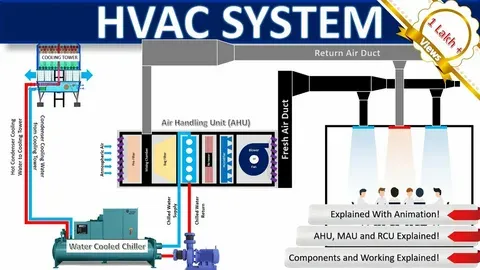
In heating mode, your furnace burns natural gas (or uses electricity) to heat air. A blower fan pushes that heated air through your home's ductwork and out through supply vents. Return vents pull cooled air back to the furnace to be reheated. This cycle repeats until the thermostat reads your target temperature.
The Cooling Cycle
In cooling mode, warm indoor air passes over an evaporator coil filled with cold refrigerant. The refrigerant absorbs the heat and carries it to the outdoor condenser unit, where the heat is released outside. The now-cooled air is blown back into your home through the ducts.
The Ventilation Cycle
Ventilation runs continuously. Your system pulls air through a return filter, which traps dust, pollen, and pollutants. In well-designed systems, a fresh air intake also brings in controlled outdoor air to prevent stale, oxygen-depleted conditions indoors.
Want the full technical breakdown? Read our deep-dive: How Does an HVAC System Work? Complete Guide for Homeowners (2026)
Main Components of an HVAC System
A typical central HVAC system in a US home consists of these components:
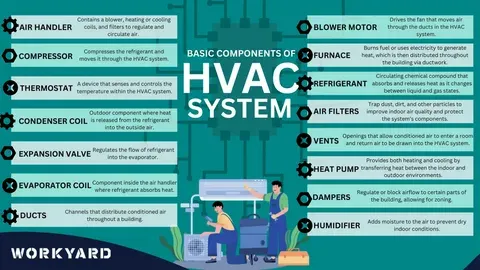
Furnace / Air Handler — Heats air using a gas burner or electric coil and houses the blower fan. Located inside your home — basement, attic, or utility closet.
Air Conditioner (Condenser Unit) — The outdoor unit that releases heat extracted from your indoor air. Sits outside beside your house.
Evaporator Coil — Absorbs heat from indoor air using refrigerant. Sits on top of or inside your air handler.
Thermostat — The brain of the system. Reads room temperature and signals when to heat or cool. Wall-mounted in your living area.
Ductwork — Channels that carry conditioned air to every room through your walls, floors, and ceilings.
Supply Vents — Where conditioned air blows into rooms. Can be in floors, walls, or ceilings.
Return Vents — Where stale air is pulled back to be filtered and reconditioned.
Air Filter — Traps dust, pollen, pet dander, and particles from return air. Located at the air handler or a main return vent.
Refrigerant Lines — Copper pipes that carry refrigerant between the indoor and outdoor units.
Condensate Drain — Removes water that condenses during the cooling process. Drains outside or to a floor drain near the air handler.
Homeowner Tip: The single most important maintenance task is changing your air filter every 1 to 3 months. A clogged filter forces the system to work harder, raises your energy bills, and shortens equipment life. A standard 1-inch filter costs $5 to $15. A dirty filter costs you hundreds.
Types of HVAC Systems Explained
The right system depends on your climate, home size, existing ductwork, and budget.
1. Central Split System (Most Common in the USA)
A split system has two main units: one inside (air handler or furnace) and one outside (condenser). Conditioned air travels through ducts to every room. This is what the majority of American homes have.
Best for: Homes already equipped with ductwork
Typical installed cost: $6,000 to $14,000
Common brands: Trane, Carrier, Lennox, Rheem, Goodman
2. Heat Pump System
A heat pump does the job of both a furnace and an air conditioner. In winter it extracts heat from outdoor air and moves it inside. In summer it works in reverse. Heat pumps are highly energy-efficient and popular in mild climates. In very cold regions they are paired with a gas furnace — called a dual-fuel or hybrid system.
Best for: Moderate climates (Southeast, Pacific Northwest, Mid-Atlantic)
Typical installed cost: $5,000 to $11,000
Note: Less effective below 20°F — a supplemental heat source is often needed
3. Ductless Mini-Split System
Mini-splits have an outdoor compressor connected to one or more indoor wall-mounted air handlers. No ductwork needed. Each indoor unit controls its own zone independently — ideal for room additions, older homes, or apartments.
Best for: Homes without ducts, garages, room additions, zoned comfort
Typical installed cost: $2,000 to $7,500 per zone
Benefit: No duct energy losses — up to 30% more efficient in some cases
4. Packaged Unit
All components — compressor, coil, and air handler — are combined into one outdoor cabinet. Common in hot climates in the South and Southwest where the unit sits on the roof or ground.
Best for: Homes in hot climates without basements
Typical installed cost: $3,500 to $9,000
5. Geothermal System
Uses the stable underground temperature (50 to 60°F year-round) as a heat exchange medium. A loop of pipes buried underground transfers heat to or from the earth. Lowest operating costs of any system but very high upfront installation costs.
Best for: Long-term homeowners with land for underground loops
Typical installed cost: $15,000 to $30,000+
Savings: Can reduce energy bills by 30 to 70%
How Long Does an HVAC System Last?
Component | Average Lifespan |
|---|---|
Gas Furnace | 15 to 20 years |
Central Air Conditioner | 15 to 20 years |
Heat Pump | 10 to 15 years |
Ductless Mini-Split | 15 to 20 years |
Boiler | 15 to 30 years |
Geothermal System | 20 to 25+ years |
Ductwork | 25 to 50 years |
Thermostat | 10 to 15 years |
The 5,000-mile rule is a useful guideline: multiply your system's age by the estimated repair cost. If that number exceeds $5,000, replacement is usually the smarter financial decision.
Related: HVAC Repair vs Replacement Cost Guide 2026 — City-by-City Breakdown
HVAC System Costs in 2026
Costs vary widely by system type, home size, and location.
System Type | National Average (Installed) |
|---|---|
Central AC Unit Only | $3,500 – $7,500 |
Gas Furnace Only | $2,500 – $6,000 |
Complete Split System (AC + Furnace) | $6,000 – $14,000 |
Heat Pump (Full System) | $5,000 – $11,000 |
Ductless Mini-Split (1 zone) | $2,000 – $6,000 |
Geothermal System | $15,000 – $30,000+ |
For city-specific pricing:
When Do You Need HVAC Repair or Replacement?
Signs Your System Needs Repair
Weak or inconsistent airflow from vents
System runs constantly but cannot reach set temperature
Unusual noises — banging, rattling, squealing, or grinding
Water pooling or leaks around the indoor unit
Sudden spike in electricity or gas bills
Rooms heating or cooling unevenly
Troubleshooting guide: Why Is My AC Not Cooling? 10 Common HVAC Problems & Fixes (2026)
Signs Your System Needs Replacement
System is 15+ years old and requires frequent repairs
Repair cost exceeds 50% of the cost of a new unit
System uses R-22 refrigerant (phased out in the USA — parts are scarce and expensive)
SEER rating is below 14 (current federal minimum in most states)
Carbon monoxide detector triggers near the furnace
Full decision guide: HVAC Repair vs Replacement — How to Decide (2026)
HVAC Maintenance Basics
Regular maintenance is the best investment you can make. A well-maintained system lasts longer, breaks down less, and costs less to run every month.
Task | Frequency |
|---|---|
Replace air filter | Every 1 to 3 months |
Clean supply and return vents | Every 3 months |
Check condensate drain line | Once a year (spring) |
Professional AC tune-up | Once a year (spring) |
Professional furnace tune-up | Once a year (fall) |
Clean outdoor condenser coils | Once a year (spring) |
Inspect ductwork for leaks | Every 2 to 3 years |
Professional air duct cleaning | Every 3 to 5 years |
Cost breakdown: HVAC Maintenance Cost in 2026 — Service Plans vs One-Time Tune-Up
How to Choose an HVAC Contractor
Choosing the right contractor is just as important as choosing the right equipment. A poor installation can reduce system efficiency by 30% or more even if the equipment is brand new.
What to look for:
Licensed and insured in your state
NATE-certified technicians (North American Technician Excellence the industry gold standard)
Provides a written, itemized quote — not just a verbal estimate
Offers a workmanship warranty on installation (minimum 1 year)
Pulls required permits — any contractor who skips permits is cutting corners
Performs a Havc calculation before sizing equipment
Never accept an oversized system. An oversized AC cools quickly but does not run long enough to remove humidity, leaving your home clammy. An oversized furnace short-cycles, wearing out parts faster. Always insist on a localbizzinfo Havc calculation before any equipment is ordered.

Frequently Asked Questions
What does SEER mean on an HVAC system? SEER stands for Seasonal Energy Efficiency Ratio. It measures how efficiently an AC or heat pump cools over an entire season. Higher SEER = lower electricity bills. The federal minimum is 14 SEER in the northern states and 15 SEER in the South and Southwest. High-efficiency units reach SEER 20 to 28.
Is HVAC the same as AC? No. AC (air conditioning) is one part of the HVAC system. HVAC refers to the full system — heating, ventilation, and cooling together. When someone says their AC is broken, they mean the cooling portion of their HVAC system has failed.
How do I know what size HVAC system I need? HVAC systems are sized in tons (1 ton = 12,000 BTUs per hour). A rough rule of thumb is 1 ton per 600 square feet, but the correct size depends on your climate zone, insulation, ceiling height, number of windows, and other factors. A licensed contractor must perform a Manual J load calculation.
Can I replace just the AC and keep my old furnace? Sometimes, but not always advisable. If your furnace is older than 10 years, replacing both at the same time often costs less overall and ensures the equipment is matched. Mismatched equipment can reduce efficiency by 10 to 15%.
What refrigerant does my system use? Systems installed before 2010 likely use R-22 (Freon), which was phased out of US production on January 1, 2020. Refilling an R-22 system now costs $100 per pound or more. New systems use R-410A or the newer R-32 and R-454B.
Related Guides on LocalBizzInfo
This guide is part of LocalBizzInfo's 2026 HVAC authority series for US homeowners. All cost data is independently researched and verified against contractor quotes from across the United States.